Cottonseed pretreatment: delint 90-95% + dehull 35-45% + cook 110-130°C
Cottonseed pretreatment hard data and module sequence: 1) Cleaning (vibrating screen + magnetic separator + destoner) to impurities <0.1%. 2) Delinting: acid (sulfuric 8-12% bath, 90-95% lint removal, fast) or saw linter (mechanical, 70-85% removal, no chemical). Linter 5-15% of seed → cellulose/cotton-pad market. 3) Dehulling (sheller + air aspirator): hull 35-45% of seed, kernel-rich feed for higher yield (28-35% on kernel vs 14-18% on whole seed). 4) Cooking 110-130°C × 30-60 min → moisture 8-12% → 6-8%, gossypol gland rupture. 5) Grinding/stirring 1-3 mm uniform feed to barrel.
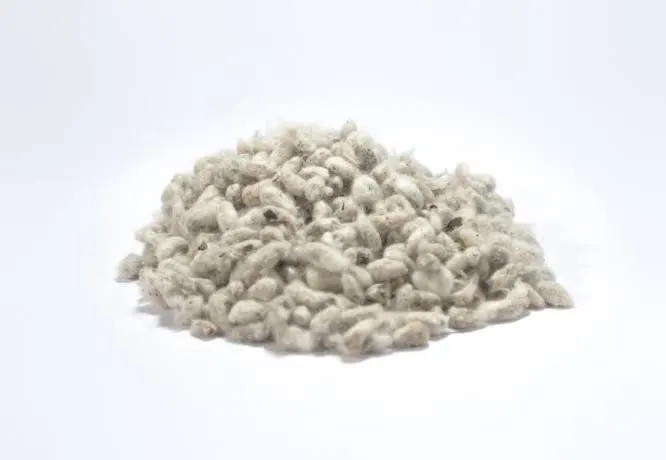
Cottonseed delinting + dehulling hard data: linter 5-15% of seed, hull 35-45% of seed, kernel 40-55%. Acid delinter 90-95% lint removal vs saw linter 70-85%. Sheller + aspirator removes hull. Cleaning to <0.1% impurities + cooking 110-130°C × 30-60 min.
Delinting options
Acid delinter (sulfuric 8-12% bath): 90-95% lint removal, faster, but acid handling + waste disposal capex. Saw linter (mechanical rotating saws): 70-85% removal, no chemical, slower throughput.
Hull management
Sheller + air aspirator: hull 35-45% of seed → kernel-rich feed. Higher yield 28-35% on kernel vs 14-18% on whole seed. Hulls go to ruminant feed, boiler fuel, or particle board feedstock.
Cooking spec
Steam-jacketed cooker 110-130°C × 30-60 min, moisture in 8-12% → out 6-8%, gossypol pigment glands ruptured (improves later refining gossypol reduction). Grinder 1-3 mm uniform particle.
Five-step pretreatment with capacity ranges
Delint: acid or saw
Acid delinter (H₂SO₄ 8-12% bath, 90-95% lint removal, capacity 2-10 t/h). Saw linter (mechanical, 70-85% removal, capacity 1-5 t/h, no chemical waste). Choose by capex + waste-disposal availability.
Clean: <0.1% impurities
Vibrating screen (40-100 mesh) + magnetic separator + destoner (gravity table). Capacity matches line throughput 1-10 t/h. Output: clean delinted seed, impurities <0.1%, stones <0.05%.
Dehull: 35-45% removal
Sheller (drum or roll) + air aspirator separates hull (35-45% of seed) from kernel. Kernel-rich feed → 28-35% yield (vs 14-18% on whole seed). Hulls collected for ruminant feed/fuel/board.
Cook + grind
Steam-jacketed cooker 110-130°C × 30-60 min (moisture 8-12% → 6-8%, gossypol gland rupture) + roll/hammer mill 1-3 mm + stirring tank for uniform feed to press barrel.
Where cottonseed pretreatment fails
- Skipping delinting (>15% lint remaining): linters clog cooker steam jackets, foul press barrel partitions, contaminate oil with cellulose fibers.
- Skipping dehulling (whole-seed feed): yield only 14-18% (vs 28-35% on kernel), cake protein 23-28% (vs 41-44% decorticated), darker oil.
- Cooking below 110°C or above 130°C: gossypol glands not fully ruptured (refining cannot reduce free gossypol below 0.045%), or protein scorching darkens oil.
- Moisture out of cooker >9% (cake bypass channels) or <5% (brittle cake) → residual cake oil >10%, yield drops 3-5 pt.
- Treating cottonseed line as 'cooked + pressed' without naming delinter type, sheller, cook temp/time, and grinder spec.
What to confirm before scoping Cottonseed Delinting + Dehulling | Linter 5-15%, Hull 35-45%, Acid vs Saw Linter
Cottonseed Delinting + Dehulling | Linter 5-15%, Hull 35-45%, Acid vs Saw Linter should not be quoted from an equipment name alone. Check feed lots, target oil, post-press handling, and packing rhythm in one scope before deciding which Cottonseed Oil Press modules stay. Cottonseed is almost always 300/325 hot press + cook + mandatory refining (gossypol).
When feed condition, moisture, impurities, batch weight, and product position are unclear, press tonnage and filter area become guesswork. Factory systems share 60 MPa and 2.2 kW motors; hot pure press is 30–40 min/barrel and cold pure press is ~2 h/barrel — cycle time matters more than brochure tonnage.
- Confirm whether feed is whole seed, kernels, pretreated material, or an existing semi-finished stream.
- Confirm whether the target is crude oil, filtered oil, bottled oil, drum ingredient oil, or a refining handoff.
- Hot cycle reference: pure press 30-40 min/barrel, ~1.5 h for 2 barrels with loading; cold pure press ~2 h/barrel, ~4.5 h for 2 barrels.
- Confirm batch rhythm, labor, changeover, retained samples, power (often 380V/50Hz/3ph), and site install conditions.
Match hot / cold models to factory hard data
When discussing Cottonseed Delinting + Dehulling | Linter 5-15%, Hull 35-45%, Acid vs Saw Linter, pin models to published factory specs — not tonnage alone.
Hot 300/325: 300–325 ton, 60 MPa system, standard barrel Ø390×800 mm / max 100 kg, pure press 30–40 min/barrel, ~1.5 h for 2 barrels with loading, 2.2 kW motor. Cold 355/400/426/480/500: 370–630 ton, integrated frame, same 100 kg standard barrel, pure press ~2 h/barrel, ~4.5 h for 2 barrels with loading; optional Ø300 high-pressure barrel max 60 kg. Residual oil target ~≤5% (peanut hot often 6–8% measured).
- Standard barrel Ø390×800 mm, max ~100 kg crushed feed; optional Ø300 high-pressure barrel max ~60 kg.
- Cylinder material 27SiMn; cold frames are integrated molded steel; hot frames are typically H-type channel steel.
- Cottonseed is almost always 300/325 hot press + cook + mandatory refining (gossypol).
project scope needs to land in equipment interfaces
After Cottonseed Delinting + Dehulling | Linter 5-15%, Hull 35-45%, Acid vs Saw Linter is clear, write the interfaces: how preparation feeds the press, how oil leaves the press, how filtration connects to tanks, and how packing receives finished oil.
Front-end input
Record feed form, daily volume, moisture, and sorting needs so pretreatment is not left to operators.
Crude sampling and refining interface
Gossypol 0.5–2.5% makes alkali + bleach + deodorize mandatory. Leave piping and sample points for refining in the first layout.
Delivery data
Prepare space, power (often 380V/50Hz/3ph), labor, target package, local rules, and acceptance method before quotation.
Clear these up first
Acid delinter (H₂SO₄ 8-12% bath): 90-95% lint removal, capacity 2-10 t/h, fast and complete. But requires acid handling + neutralization + waste-water treatment, raising capex 30-50% on the delinting section. Saw linter (mechanical): 70-85% removal, capacity 1-5 t/h, no chemical waste, lower capex. Choose acid for >50 t/d mills with waste infrastructure; saw linter for 10-30 t/d gin-side lines or where chemical handling is impractical.
These next pages move the discussion forward
Buying guides
Hydraulic vs Screw Oil Press for cottonseed: Which Fits Your Mill?
Compare hydraulic batch press vs continuous screw (expeller) for cottonseed: oil quality, cold-press ability, capacity, residual oil, labor, and when each route wins. Use this before you request a quote.
Continue →Buying guides
cottonseed Hydraulic Press Capacity: Barrels per Shift and How Many Presses
Size cottonseed hydraulic capacity with real cycles: hot pure press 30-40 min/barrel (~1.5 h for 2 barrels with loading); cold ~2 h pure / ~4.5 h for 2 barrels. Example math for 1–5 t/day small mills.
Continue →Buying guides
cottonseed Oil Press Inquiry Checklist: Data That Gets a Real Quote
RFQ checklist for cottonseed hydraulic oil press projects: seed form, kg/shift, hot/cold, filtration, cake path, power, country, and photos. Incomplete inquiries get catalog replies — complete packs get model counts and line scope.
Continue →Send this page's requirement to the factory
Bring feed condition, target output, and site constraints, and we will continue from what this page covers.